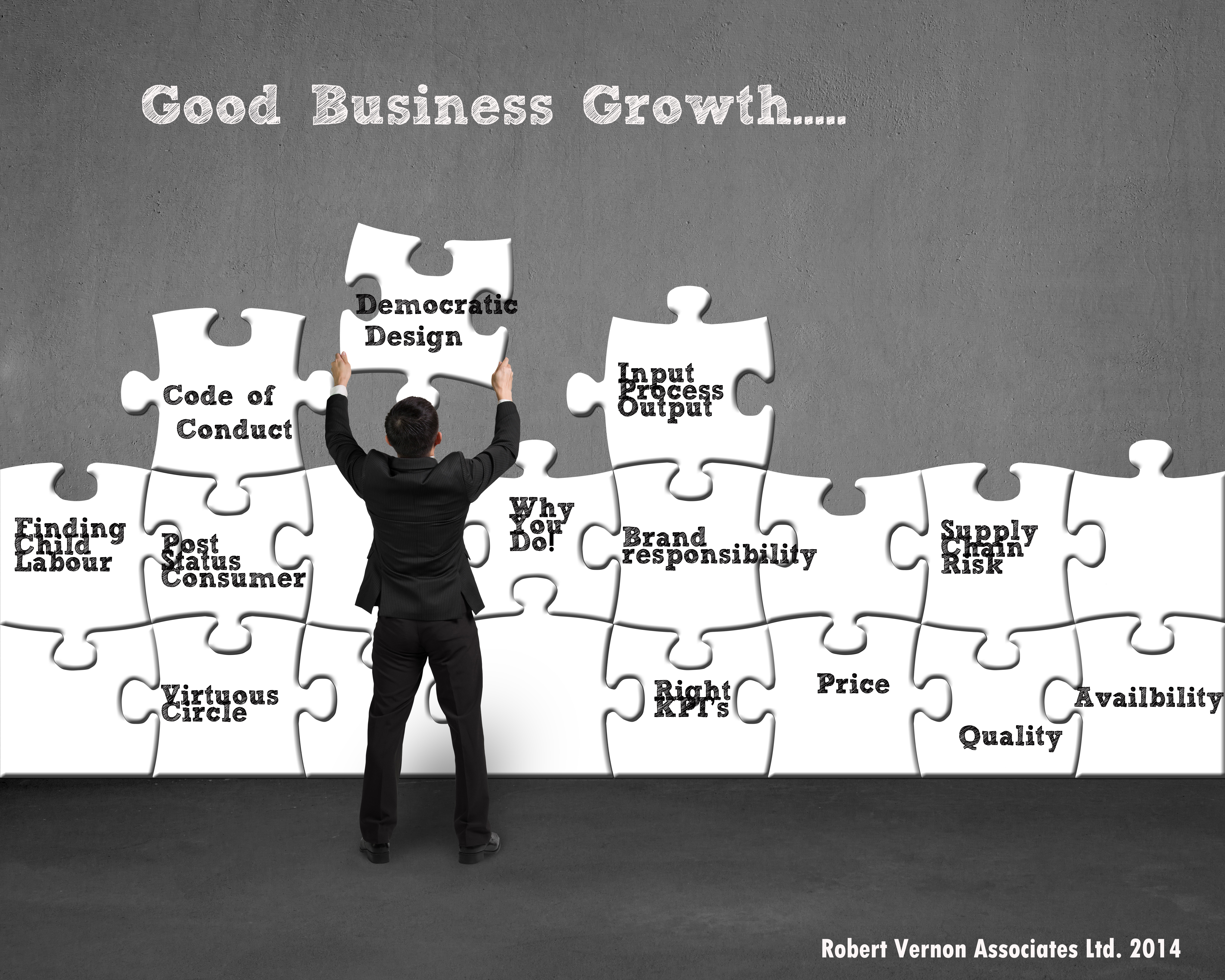
Democratic Design for Good Business Growth…

Tags

, , , , ,

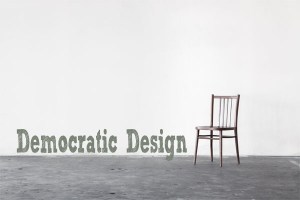
Democratic Design_aIt starts with designing a great product at a low price. There is skill in designing an architect’s chair for 4000 dollars, but the greater skill is in designing a chair of fantastic form and function for 40 dollars!!

Democratic Design is all about giving the majority of us in the Developed world a great quality product at a low price. Good form and function should not only be for the rich.

In the Developing world Democratic Design is about using the right sustainable materials and production techniques that secures good working conditions, wages and environmental security.

The drivers to secure democratic design are:

Design: Adapted to high volume and efficient production with innovative design – aiming to achieve a low priced product.

Raw Materials: Choosing the right materials and processing techniques to secure a sustainable and low cost supply.

Production: Safe and compliant working conditions with no danger to the environment. An efficient and effective factory.

Quality: Conforms to the requirements and specifications.

Installation: Good final assembly and installation techniques at the product’s point of use – a vital step in the design process.

It is not an easy path to take. Its about achieving a balance in the above drivers. It’s not always evident in cheap brands and is never apparent in the exclusive high price designer products. The big name fashion designers are celebrated on the cat walks and in glossy magazines, but the real heroes of design are those that can achieve Democratic Design.

If you would like to know more about this and Good Business Growth, please contact us for an initials discussion on how we can help your business..
The RVA publication series on Good Business Growth..

Tags

, , ,

The Articles...

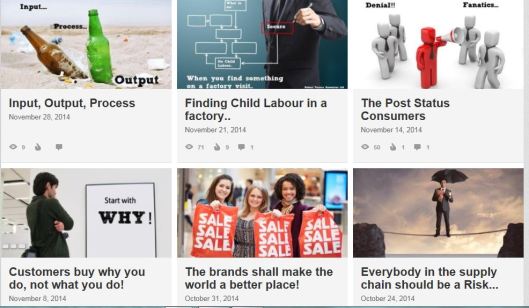
Robert Vernon Associates have over the last few months published a series of Good Business Growth articles on Linked In. They were produced to secure the wider distribution of the concept; provide specific details and generate ideas and understanding for readers.

There are currently 12 articles, with more to come. The original writing focus was  for was International Sourcing/Supply Chain aiming to explain Good Business Growth. However, within the series, the articles can stand on their own for management, leadership and business operational understanding in:

  • Customer behaviour and expectations
  • Business ethical and code of conduct issues and management
  • Communication: Presentation and simplification of information
  • The Process: from Design to Execution

posts Nov 2014

These publications are concise and to the point, allowing them to be individually useful or part of a total explanation and  gateway to more detailed information..

Please contact us if you would like to discuss any specific topics raised in the articles or the total concept of Good Business Growth..

Mark K. Astley

Code of Conduct: The DNA of an organisation

Tags

, , , , ,

Customer or Organisation’s Code of Conducts are now in all parts of the supply chain. They have been an integral part of the office or factory noticeboard for well over 10 years..

Behind the code of conduct document is the reality of compliance to a raft of legislation, directives, procedures, maintenance plans and HR reports. To handle this requires departments and specialists in various operations. This is a necessity, but it must not be allowed to become a silo of function, working in isolation to its own plans, responsibilities and reporting mechanisms, with the rest of the operation being grateful that they don’t have to deal with all that stuff!!!

A code of conduct should be in the DNA of a company. Based on Robert Vernon Associates many years of varied experience  we have concluded that essentially there only 4 basic elements in any code and all businesses and their operations should be managing these elements, irrespective of customer or legislative requirement:

  1. Secure Social Conditions at the workplace
  2. Secure environmental performance and improvement
  3. Secure operational health and safety work
  4. No Child Labour in the factory

Breaking down a code of conduct into basic elements helps to simplify what at times can be something either too abstract, marketing verbage or too technical and detailed. Simplifying with basic elements as communication drivers for the workforce will help secure and achieve engagement and ownership in the operation. This helps to identify the needs, which can then be prioritised and delegated. Once the needs are clear then actions can be devised on the shop floor to handle non conformances or operational improvements, instead of plans being drafted in the supply chain office or company headquarters by Sustainability Teams.

A sustainable, compliant, efficient business depends upon everybody working together to achieve good business growth. The company Code of Conduct informs all stakeholders about an organisation’s values – in essence why they exist! They are no longer marketing gimmicks to be dusted down when the customer or senior managers plans a visit. Compliance to the requirements is vital for the customer offer. It needs to be assured 365 days a year not just on audits. Therefore engagement by everybody in the business is vital. Even if you do not agree with our 4 basic elements find your own, as a way of communicating and securing involvement. Avoid the silo of functions where its only one specific department or team that knows or thinks it knows what’s going on!!

Robert Vernon Associates can help turn your company’s code of conducts, values statements and supplier compliance requirements into reality. Making them not just the DNA of your company but that of your Supply Chain. For more information and a discussion please contact us..

Mark K. Astley

E6 Enterprises appointment

Tags

, , ,

RVA announces its appointment as management consultants to the autonomous power generation company:

E6 Enterprises


Robert Vernon Associates will provide guidance, input and assistance in the following:

  • Business Strategy Development
  • Management and Leadership Development
  • Research and Development finance and marketing management
  • Sustainability Management

E6 Enterprises are the developers and innovators of the of the Lower Energy Drive Array – the pat pending ‘Simkarray’ system.

Finding the right tools and KPI’s…

Tags

, , , ,

Finding the right tools

Key Performance Indicators drive everything in today’s business. Very often though, there are too many and they can sometimes damage the operation of a company through incorrect application and/or sub optimisation by individuals and teams.

KPI’s should be based on the right selection of business tools, techniques and methods.. For Good Business Growth the 4 Key Areas of managing and measuring the supply chain are:

  • Availability: Production/logistics planning – Select the best techniques to plan and secure factory/supply chain capacity and capability?
  • Quality: Select the best tools to minimise the risks in product design and production. Then decide on the best process control method to reduce quality control at final delivery.
  • Social and Environmental Compliance: Find the best methodology to secure 365 days of operation rather than 2-3 days of a compliance audits.
  • Price Development: Agree the tools, techniques and methods to work with the Vendors, rather than negotiating with them.

Find the right tools, techniques and methods in the above areas, then the right KPI’s will follow.. They should be simple, transparent, continually reviewed and maintained with your supply chain team and vendors. Please contact us if we can help your organisations to achieve this..

Mark K.Astley

Everybody should be a Risk Manager!!

Tags

, , , ,

shutterstock_123603859In all businesses there are risks; from the small service delay to the major catastrophe!!

Unfortunately most of us think of risk in terms of the major disaster and by the way its a professional risk managers responsibility to calculate and determine what ‘could’ happen.

This kind of thinking is costing the supply chain a lot of wasted time and resource. For the sake of a few minutes, lifting up our heads and looking beyond current challenges, we can very easily use the concept of risk management in quick and easy ways to avoid future issues in the supply chain or the product..

Identifying a potential hazard for your product, social/ environmental compliance and supply chain operation can be done through various team meetings. Once hazards have been agreed then the following elements in determining the risks are vital to unlocking the potential benefits:

  • How Serious is it (death being the most serious)
  • Frequency ( how many times it could happen)
  • Can it be detected ( Can the hazard be seen)

Formal risk analysis has mainly been the domain of the engineers and number crunchers and has not been used enough in practical ways by operational teams. Its worse in the UK where the above 3 elements have not always been applied, resulting in some poor and very often media ridiculed decisions in governmental departments. (no more conker fights in the schoolyard).. This has resulted in 40% higher costs for UK health and safety management when compared with Germany.

All parts of the supply chain can on a daily basis conduct simple but formal risk analysis. They can easily determine the hazards and then using the above 3 elements calculate the risks and what preventive actions if any, are to be prioritised and implemented!! This need not be complicated, time consuming or costly to do!! The savings and improved service levels will be tremendous in terms of; improved cost management, vendor efficiency, employee job satisfaction and customer service levels.

Find the best, simple and effective method for your organisation to conduct risk analysis; try not to use the engineering and number crunching solutions. Its probably best to avoid the methodology used by UK government departments!!

As part of our Good Business Growth training offers, RVA conducts PRAS – Risk Analysis training. With all our training courses, this is conducted in a very practical and fun way.. Please click here for more details.

Mark K.Astley

Example: How to handle a possible child labour incident..

Tags

, , , ,

shutterstock_198620522When operating and buying in developing countries, companies must be well prepared for various eventualities. One of the most sensitive and extremely urgent to resolve is discovering Child Labour in a factory. Our own experience  in this matter has not been positive; with confusion, delays and extensive disagreements on the evidence discovered and actions to be taken. On two occasions in the past 6 years it became necessary to stop production and hold deliveries until the issue was resolved.
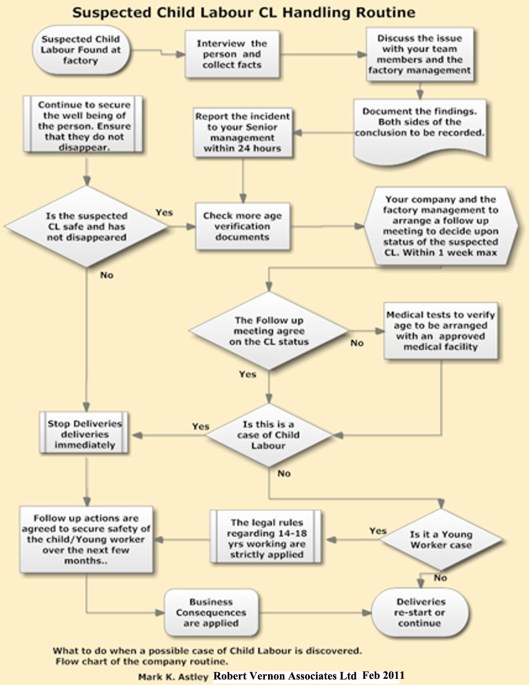

Very often company instructions are available to guide buyers and factory suppliers when a possible incident of child labour is found on the factory floor. However, like most things when these directives are more than two pages, the stakeholders are not familiar enough with the instructions. Valuable hours and days can be lost before all parties become aligned in agreeing and resolving the situation – in some cases this does not even happen if the situation drags on too long!!

The most important point when suspected Child Labour is found is to put the safety and well being of that person at the front of everything. All decisions must be made with this mind-set firmly secured.

RVA have witnessed and has been frustrated at the failure of stakeholders to get to grips with the requirements and the decisions to be made. This has been mainly due to the lack of understanding on how the situation should be handled and processed. To address this, Robert Vernon Associates have produced a one page Process Flow chart to handle a possible Child Labour report. It is based on various existing company instructions and our own experience in capturing all actions and decisions to be made; providing work colleague and suppliers a simple guide to know and understand beforehand what to do, or if an incident does happen then a tool to use and guide everybody in a transparent and efficient way.

We hope below is useful for any international sourcing and factory operations to adapt and utilise. We also hope it proves the power of flow charting as a communications tool. Please do not hesitate to contact us if you require further details and assistance in developing robust international sourcing tools and guidelines. The example below is just one part of our Good Business Growth operational tools package.

cl-flow-chart-_what-to-do4


The Cost Down Programme – CDP

Tags

, , , , ,

Robert Vernon Associates announces a new one day activity to its expanding programme of Good Business Growth training and facilitation courses:

THE COST DOWN PROGRAMME: CDP

shutterstock_117821158

Introduction:  A one day activity programme, conducted on the production floor to identify and reduce article and production costs in a win/win situation for buyers and suppliers.

The Course Objectives: Secure current business and improve potential future volume levels by finding ways to reduce the price for the final customer, improve costs for the retailer and improve profitability in the supply chain.

The CDP is highly activity based, conducted on a client’s nominated production floor.. For more details please take a look at the activity details in this link..One Day on site training course_CDP.

If you and your company are interested to run Cost Down activities in your factories or in your suppliers please complete the contact form.

Go back

Your message has been sent

Warning
Warning
Warning
Warning
Warning

Warning.


Golden Circle of Human Motivation..

Tags

, , , , , , , ,

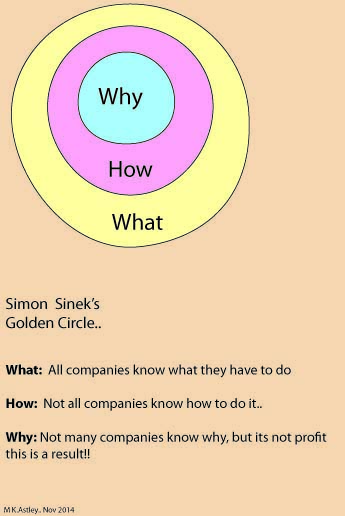
We are big fans of Simon Sinek’s ‘The Golden Circle’ of Human Motivation. A simple concept on how companies and leaders shall inspire their workforce and their customers.

Golden CircleAll companies know WHAT they have to do – sell a product or provide a service. Most companies will know HOW to do this, through their operating procedures, directives or systems. Not a lot of companies know WHY they do what they do.. Why do they exist, how do they justify their existence? Its not for profit as Sinek’s says, because profit is a result not a why!

From a company where RVA has had a lot of experience with, the Golden Circle can be applied. shutterstock_189696824

The IKEA vision is to create a better everyday life for the many people.’

This is a company that works from the inside to the out. Their values and justification to exist are deeply inscribed in the why. With their vision they inspire customers to have fabulous looking homes filled with affordable well designed/quality products, made and supplied by people who care. This vision then inspires their co-workers to do great things in the store, in the warehouse and at the factory. The many people include the factory operators as well as the customers.

Companies regardless of their size and industry inspire from the inside of the circle to the out – their customers buy Why they do not the What they do. Apple Inc prove this – they are not the cheapest on the market and they are not the most innovative but their vision about doing things differently and challenging the status quo is an inspiring message. MP3 players, tablets and smartphones existed on the shop shelves before Apple delivered their products, but it was Apple that created the markets for these devices – they inspired us to buy and use..

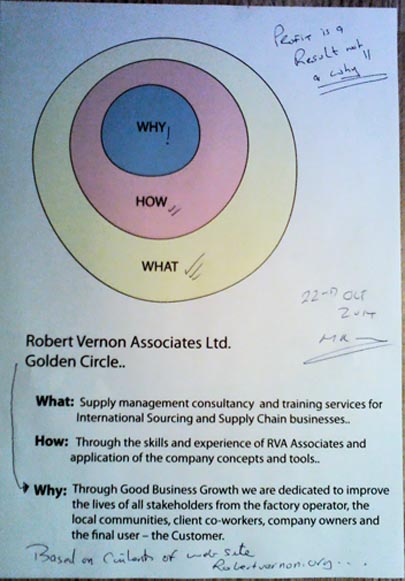
At  Robert Vernon Associates; we recently looked at our offer and compared it against Sinek’s Golden Circle..

Mark K.

kr

Create a Supply Chain Virtuous Circle..

Tags

, , ,

Linkedein Circle ed1Securing a competitive offer is getting tougher!

The basis to achieve and a have successful competitive offer are the 4 parts of Good Business Growth:

  • Securing the product to specification – Quality.
  • Delivery on time in the most cost efficient way – Availability.
  • Socially and Environmentally assured – Code of Conduct compliant.
  • A Low Price with a meaning – a functioning, well designed, guilt free product that is available on the shelf for the customer to buy.

All the above are integral – they are linked; if one goes down then the business is at jeopardy and if the buyer/vendor’s are not careful they can quickly go into a vicious circle. However, at the same time if one of the 4 parts performs to a higher level then it will in turn help bring the rest of the business to a level of continuous improvement – a virtuous circle.

From the design, merchandising, production, and compliance teams through to the logistic operations they all need to be aligned. If they work, plan and KPI separately in the above, they will create a vicious circle. Avoid this through the application of Good Business Growth and create a Virtuous Circle.

Mark K.Astley